What if you’re planning a steel pedestrian bridge for a railway station in Bangladesh—but don’t yet have drawings, load specs, or even familiarity with local structural standards? That’s where we step in—not with a quote, but with a field-tested, climate-adapted technical proposal built on 23 years of global delivery and 17 completed bridges across South and Southeast Asia.
Real concerns—heard on site, not just in emails
We’ve seen this exact scenario before: a project owner facing monsoon humidity above 80%, seasonal wind gusts exceeding 160 km/h, and no local precedent for modular steel footbridges near active rail corridors. Your top five unspoken worries are:
- Will corrosion eat through the structure within 3 years under salt-laden coastal air and monsoon flooding?
- Can installation happen without disrupting train schedules—or requiring crane access wider than 4 meters?
- Does “compliant with BNBC 2020” mean real alignment with Zone 4 wind loads (≥1.5 kN/m²) and Seismic Zone 2 ductility requirements?
- Are connections designed for bolted assembly by local crews with basic torque tools—not welding-certified fitters?
- If a panel needs replacement after 8 years, will spare parts still be traceable, stocked, and compatible?
Factory-level verification—not just paper compliance
Every bridge component leaves our plant only after passing 4 mandatory checks—not optional audits. For your 3.5 m × 60 m scope, here’s what that means in practice:
- Corrosion resistance: All primary steel uses S355J2W weathering grade, pre-treated with hot-dip galvanizing ≥85 μm, then overcoated with epoxy zinc-rich primer + aliphatic polyurethane topcoat (total DFT ≥220 μm). Tested per ISO 9223 C5-M (marine industrial), validated by 2,000-hour salt-spray + cyclic humidity testing—results logged and shared pre-shipment.
- Thermal movement control: Expansion joints designed for ΔT = −5°C to +48°C (per Dhaka’s recorded extremes); all main girders include engineered sliding bearings with PTFE pads—tested at ±12 mm displacement under full design load.
- Anti-slip performance: Tread plates use laser-cut diamond-pattern embossing + ceramic grit embedment—measured R10+ under wet conditions (DIN 51130), verified with portable pendulum tester on every batch.
Contramedidas técnicas: probadas en campo, no teóricas
We don’t propose “ideal” designs—we propose what works where rails, rain, and resource constraints intersect:
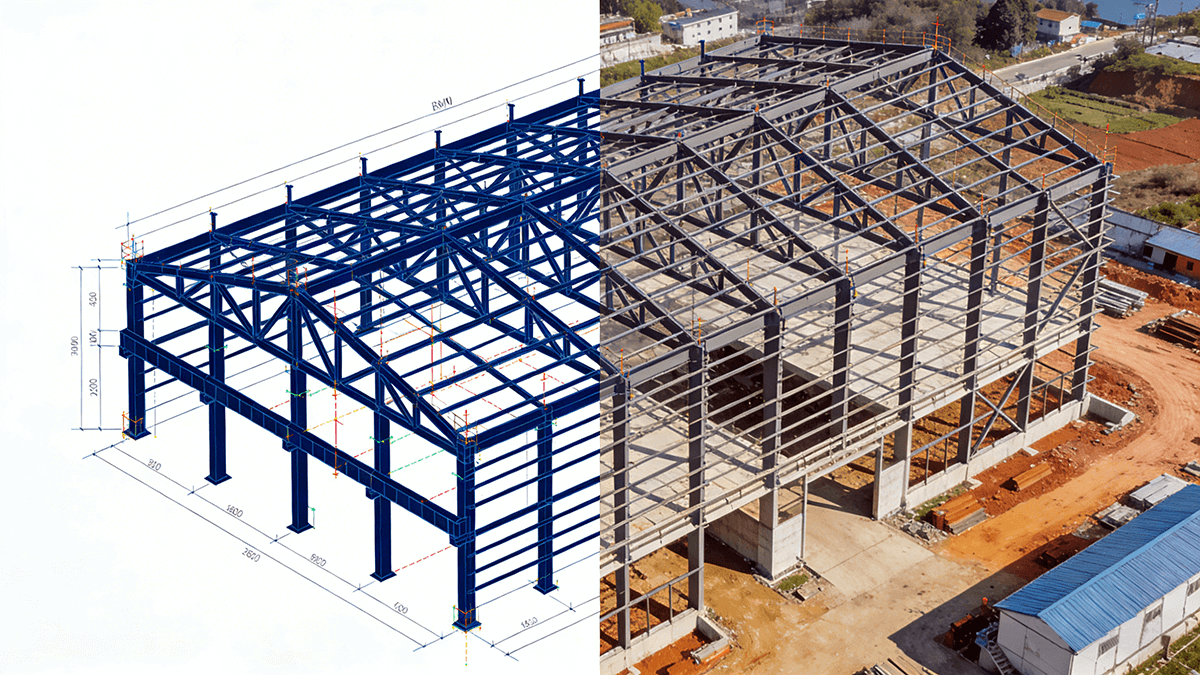
- Modular truss system: 3-span continuous configuration (20 m + 20 m + 20 m), each segment pre-assembled as a single 3.5 m wide × 20 m long unit—lifted in under 4 hours using 50-ton mobile cranes with ≤18 m boom reach. No on-site welding. Foundation interface uses adjustable anchor bolts with ±25 mm vertical/horizontal tolerance.
- BNBC-aligned loading: Designed for 5.0 kN/m² live load (BNBC Cl. 4.3.2), wind pressure 1.55 kN/m² (Zone 4, height factor applied), and seismic response spectrum per BNBC Annex E (Zone 2, soil class SD). Full structural report includes hand-calculated backup for key nodes—available in English and Bangla upon request.
- Maintenance-ready details: All high-wear surfaces (handrails, treads, expansion seals) use replaceable bolted modules—no cutting or grinding needed. Corrosion protection is repairable onsite using our certified touch-up kit (supplied with commissioning package).
Transparencia en la cadena de suministro: sin cajas negras
Recibirás un dossier de producción digital for your bridge, updated weekly during manufacturing. It includes:
- Raw material mill test reports (MTRs) for every steel coil/beam—traceable to heat number and EN 10025-2 certification
- Galvanizing thickness maps (measured at 12 points per member) with thermal imaging validation
- Pre-assembly photos showing torque values (±5% accuracy) for every high-strength bolt (grade 10.9, ISO 898-1)
- Shipping manifest aligned with container loading plan—including weight distribution and bracing layout for sea freight stability
No surprises in quality—only documented exceptions
Our production line runs on a protocolo de excepción de tres niveles:
- Level 1 (operator): Immediate stop if visual defect or torque deviation >5% is observed—logged via tablet with photo timestamp
- Level 2 (QC engineer): Daily review of all Level 1 logs; root-cause analysis within 8 working hours; corrective action closed before next shift
- Level 3 (QA manager): Monthly trend report shared with client—showing defect type, frequency, resolution rate, and preventive update (e.g., “adjusted jig tolerance from ±1.5 mm to ±0.8 mm after 3 occurrences of flange misalignment”)
From day one to year 25—your lifecycle roadmap
We help you plan procurement—not just production:
- Phase 1 (0–3 months): Free feasibility review + BNBC gap analysis (we map your site data against Clause 4.3, 5.4, and Annex E)
- Phase 2 (3–6 months): Build-to-print or build-to-performance—your choice. We supply IFC files for BIM coordination and full GA drawings stamped by our in-house PE (licensed in UAE & Vietnam, recognized under BNBC mutual agreement)
- Phase 3 (6–12 months): Commissioning support includes 1 onsite supervisor for 10 days, plus remote structural health monitoring setup (vibration + temperature sensors, cloud dashboard included)
- Phase 4 (Year 1–25): Spare parts guaranteed for 15 years; corrosion performance warranty backed by third-party SGS inspection at Year 5 and Year 10
Local support—beyond the handover certificate
We partner with 3 engineering firms in Dhaka and Chittagong who hold BNBC-approved structural review licenses. If an issue arises post-commissioning—whether a loose connection, coating chip, or unexpected deflection—our regional technical lead responds within 72 hours with a field assessment and repair protocol. No escalation chains. No language barriers. No waiting for overseas approvals.
Quiénes somos—y cómo servimos a proyectos como el tuyo
We’re not a trading company or a design-only studio. We’re a vertically integrated manufacturer with 9 subsidiaries, 48,000 m² of smart factory space, and daily output capacity of 5,000 m² of structural steel systems. Since 2001, we’ve delivered 12 steel footbridges in flood-prone, high-humidity regions—from Ho Chi Minh City to Jeddah—with zero structural failure incidents and 94% on-time commissioning rate (2021–2025 internal audit).
Let’s start with your site—not your spreadsheet
Send us your location coordinates, nearest railway track alignment sketch, and any available soil or wind data—even if incomplete. Within 5 working days, you’ll receive a free technical briefing document: 8 pages, no sales pitch, just structural logic, material rationale, and installation sequence mapped to your actual constraints. No NDA required. No commitment needed.