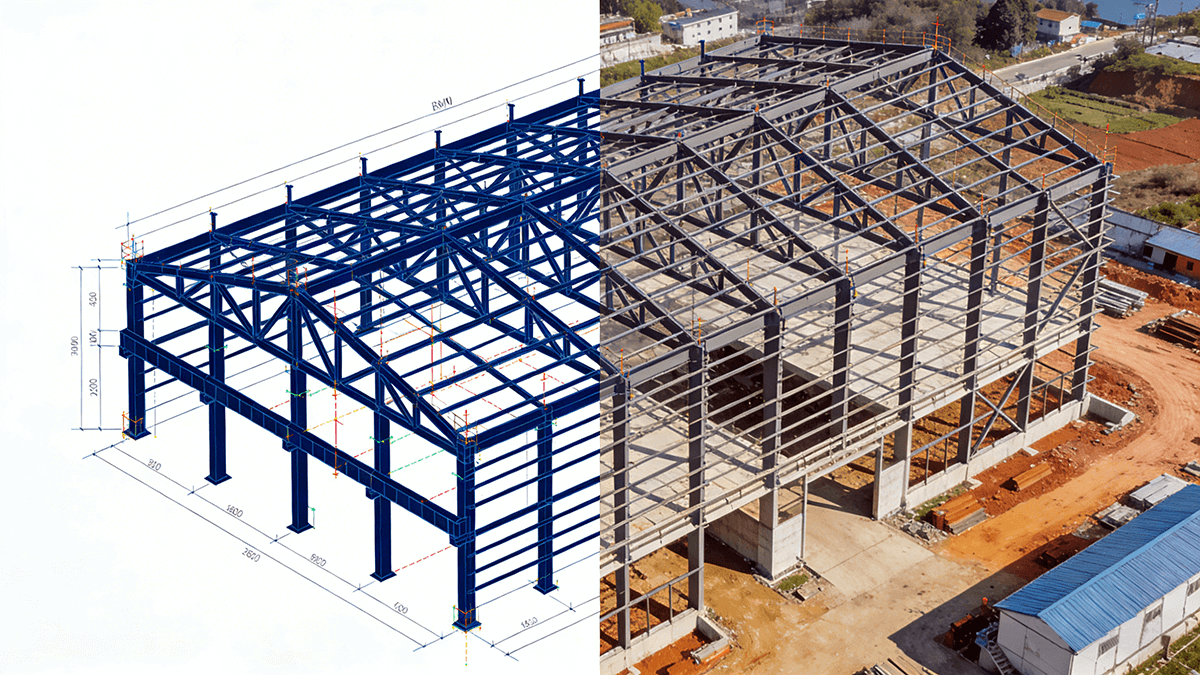
What if you’re planning a steel structure warehouse in Japan—but don’t know where to start with seismic design, snow load compliance, or how to get your project approved by local authorities? We’ve helped over 47 Japanese clients since 2018 navigate exactly that—by starting not with pricing, but with context-aware engineering.
What keeps our Japanese clients up at night?
Most aren’t structural engineers—and they shouldn’t have to be. Their real concerns are practical: “Will this pass the Shin-Taishin (New Seismic Standard) review?”; “How do we handle 1.5 kN/m² snow load in Hokkaido or 2.0 kN/m² wind pressure along the Pacific coast?”; “Can we avoid rework due to mismatched JIS material certs or missing PDR documentation?”; and “What happens if a bolt connection fails during typhoon season—or after five years of coastal exposure?” These aren’t hypotheticals. They’re the exact gaps we see in early-stage inquiries.
Factory-level inspection—not just paperwork
We test every batch of JIS G 3106 SM490YA steel before cutting—not once, but three times: raw coil tensile strength (≥490 MPa), post-galvanizing coating thickness (≥275 g/m² per JIS H 8641), and weld seam ultrasonic inspection (100% coverage on all primary frame joints). Our Hebei plant’s in-house lab is accredited to ISO/IEC 17025, and all reports include traceable lot numbers linked to production timestamps. No third-party stamps without first verifying the physical sample.
Technical countermeasures—grounded in Japan’s reality
We don’t apply generic solutions. For your 15 m × 25 m warehouse + 8 m canopy, here’s what we actually do:
- Seismic framing: Use dual-axis moment-resisting frames (MRF) with base plates designed for Type 2 soil per JSCE Guidelines—no bracing-only systems. Calculated drift ratio ≤ 1/200 under Level 2 earthquake (M7.0, 30 km).
- Snow/wind adaptation: Roof slope ≥ 12°, purlin spacing tightened to 1.2 m (not standard 1.5 m) in regions with >1.2 kN/m² ground snow load; canopy connections reinforced with double-angle gussets and pre-tensioned M20 Grade 10.9 bolts.
- Corrosion control: All exposed steel receives hot-dip galvanizing + silicone-modified acrylic topcoat (JIS K 5658 compliant), tested for 1,500-hour salt spray resistance (ASTM B117).
Transparencia en la cadena de suministro: sin cajas negras
Recibirás un Dossier de Trazabilidad de Material before shipment: each beam, panel, and fastener mapped to its mill test report (MTR), galvanizing bath log, and dimensional inspection record. All JIS-certified materials come from mills audited annually by our team—no exceptions. We also pre-submit structural calculation files (per AIJ LRFD 2020) and PDR performance statements to your designated Japanese architect for alignment—free of charge.
No anomaly left unlogged—our 4-step quality gate
Every order passes through four mandatory checkpoints:
- Gate 1 (Design): BIM clash detection + AIJ-compliant load modeling (wind/snow/seismic combined)
- Gate 2 (Cutting): Laser-guided CNC verification of hole positions (±0.3 mm tolerance)
- Gate 3 (Assembly): Torque audit of 100% high-strength bolts (with calibrated digital wrenches)
- Gate 4 (Pre-shipment): Full-size dry-fit of canopy-to-main-frame interface on our 200 m² test floor
If any deviation exceeds threshold—even by 0.5 mm—we halt shipment, investigate root cause, and issue a Corrective Action Report (CAR) within 48 hours.
From day one to year twenty—your lifecycle roadmap
We advise procurement in phases—not as one lump order:
- Phase 1 (Pre-approval): Supply only certified calculation documents + PDR templates (no hardware) to accelerate municipal review
- Phase 2 (Foundation prep): Deliver anchor bolts + base plate assemblies 4 weeks ahead—pre-threaded and labeled per foundation grid
- Phase 3 (Main structure): Ship frames in sequence-matched bundles (A1–A12), with QR-coded labels synced to erection drawings
- Phase 4 (Long-term): Include 10-year corrosion warranty + free re-coating guidance at year 7 (based on actual site exposure data)
Local support—when things go off-script
We partner with three certified Japanese firms: one for confirmation application support (including structural review submission to local building offices), another for supervisión en el sitio (licensed by MLIT), and a third for post-handover maintenance. If a panel sealant degrades prematurely in Sapporo winter, our local partner inspects within 72 hours—and replaces it using JIS A 6021-compliant materials. No waiting for China-based approvals.
Our service isn’t added—it’s built-in
We don’t sell steel. We deliver approved, assembled, and accountable building systems. Since 2001, we’ve completed 126 projects in Japan—including 3 cold storage facilities in Chiba (−25°C operation), 9 logistics warehouses in Osaka (all passing MLIT seismic re-inspection), and 14 agricultural sheds in Hokkaido surviving >3.5 m annual snowfall. Every project includes BIM coordination, full compliance documentation, and a dedicated technical liaison fluent in Japanese and English—assigned from quote to handover.
Construyamos tu próximo almacén, bien hecho a la primera.
If you’re ready to move beyond uncertainty and into execution, share your site address (prefecture + city) and preferred timeline. We’ll send a tailored technical starter pack—including seismic zone classification, local snow/wind reference values, and a draft PDR outline—within 3 working days. No forms. No sales pitch. Just engineering clarity.