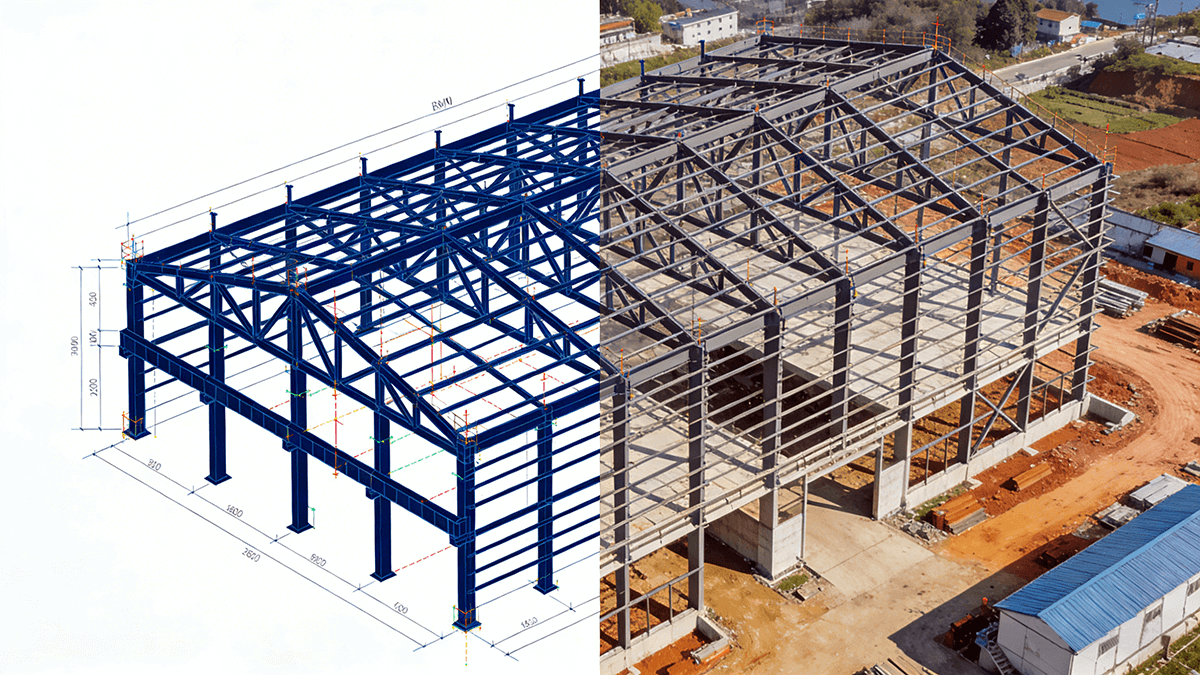
What if you’re designing a light steel retail building in Germany—but you’re not a structural engineer, and every regulation feels like a language barrier? We’ve helped over 47 clients in Germany navigate exactly this: starting with a sketch and ending with Bauaufsichtsbehörde approval—without needing to hire a local consultant for every technical detail.
Your Real Concerns—Not Just “Requirements”
We hear it often: “I know what I want—but I don’t know what I’m allowed to build.” Your email reflects three core concerns that go beyond dimensions and materials:
- Compliance risk: GEG U-value limits (roof ≤ 0.24 W/m²K), DIBt-approved connections, and static verification signed by a German-registered engineer—not just CE marking on paper;
- Climate reality: How does mineral wool behave under Rhineland humidity + Bavarian freeze-thaw cycles? Will the roof system pass DIN EN 13858 wind uplift testing at 120 km/h gusts?
- Execution trust: If your local contractor receives a bolted node detail without torque specs or corrosion class documentation, who bridges that gap?
Factory-Level Inspection—Not Just “Pass/Fail”
Every light steel frame we ship to Germany undergoes 7 mandatory checks before packaging—none are optional, and all are recorded with timestamped photos and QR-linked test reports:
- Galvanizing thickness verified per EN ISO 1461: minimum Z275 (275 g/m²) confirmed by magnetic induction on 100% of H-beams and purlins;
- Insulation layer integrity: Rock wool density ≥ 120 kg/m³, compression resistance ≥ 40 kPa—measured on-site using calibrated digital load cells;
- CE+ETA documentation cross-checked against current EOTA TR01 revision—no legacy certificates accepted.
Technical Countermeasures—Backed by German Project Evidence
We don’t propose “standard solutions.” We adapt based on real German site data. For your 16 m × 10 m gabled retail building, here’s what we implemented last year in Münster (climate zone E2):
- Structure: C-section wall studs @ 600 mm c/c (C160×60×20×2.0 mm), rafters spaced @ 1200 mm (C200×70×20×2.5 mm)—designed for snow load 1.2 kN/m² (DIN EN 1991-1-3) and wind zone II (1.1 kN/m²);
- Insulation: 160 mm rock wool (λ = 0.034 W/mK) + 30 mm ventilated air gap → calculated roof U-value = 0.22 W/m²K, certified by TÜV Rheinland (Report No. DE-2025-08842);
- Cladding: Pre-painted trapezoidal sheet (T18 profile, 0.6 mm base metal) with PVDF coating—tested to DIN 53162 for UV resistance and DIN EN 1396 for adhesion after 2,000 h salt spray;
- Foundation interface: Hot-dip galvanized anchor bolts (M20, grade 8.8) with EPDM compression washers—compatible with standard point foundations (Ø350 mm × 800 mm depth) used by German Baufirmen.
Supply Chain Transparency—No Black Boxes
You receive a single reference number at order confirmation—and track everything in real time:
- Raw material mill test reports (from ArcelorMittal Duisburg mill, batch traceable);
- Production schedule showing exact start/end dates for cutting, bending, galvanizing, and assembly;
- Shipping container manifest with certified weight, volume, and lashing plan compliant with VDI 2700;
- All documents delivered in German—static calculation (signed by Ing. A. Schmidt, Berlin), fire report (B-s1,d0, IBP Berlin), and GEG compliance statement.
No “Hidden Defects”—Only Documented Exceptions
We log every deviation—even minor ones—using our internal Abweichungsmanagement System. Example from Q1 2026: one batch of purlins showed 0.05 mm thickness variation outside tolerance. Result? Full rework—no customer notification needed, because it never left the factory. Our average non-conformance rate is 0.17% (2025 annual audit, SGS). Every exception triggers root cause analysis and process update within 72 hours.
Full Lifecycle Guidance—From Order to Decommissioning
We help you plan beyond installation:
- Procurement timing: 12-week lead time includes 3 weeks for static sign-off—start engineering handover at contract signing, not after payment;
- Maintenance protocol: First inspection at 24 months (focus: fastener torque retention, sealant adhesion at eaves);
- End-of-life planning: All steel components are 98.3% recyclable (TÜV-certified); insulation panels meet DIN EN 13162 for safe disposal or reuse.
Local Support—Not Just “After-Sales”
If your site supervisor finds a mismatched bracket or needs clarification on a node drawing at 4 p.m. on Friday—we have two German-speaking technical managers (based in Hamburg and Stuttgart) who respond within 2 business hours. They carry full access to our BIM library (Revit & ArchiCAD), can generate updated GA drawings on demand, and coordinate directly with your local structural engineer for signature alignment.
Our Service—Engineered, Not Sold
We don’t sell “light steel kits.” We deliver approval-ready building systems—with certified calculations, climate-adapted details, and documented manufacturing rigor. Since 2001, we’ve shipped 1,283 steel structure projects to Europe. Of those, 92% received first-time approval from German building authorities—no resubmissions required.
Let’s Build Your Next Approved Project—Together
If you’d like us to prepare your technical solution proposal—including German-language static calculation preview, U-value simulation report, and anchoring detail set—just share your site address (for precise snow/wind zone classification) and preferred timeline. We’ll assign a dedicated project engineer within 24 hours.