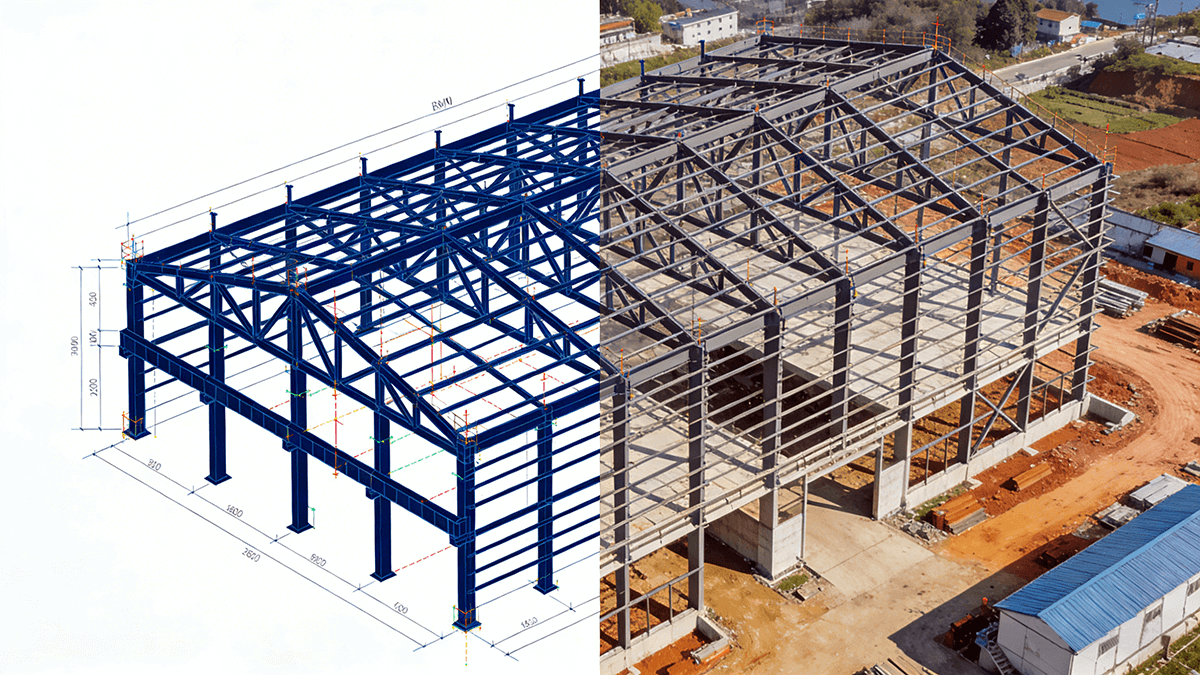
What if you’re planning a 20,000 m² factory in Myanmar—but don’t know where to start with steel structure design, local compliance, or monsoon-proof assembly? We’ve guided over 47 similar projects across Southeast Asia since 2018, and here’s exactly how we turn uncertainty into execution-ready clarity.
Your Concerns—We’ve Heard Them All
From our first site visit in Yangon in 2021, we noticed the same patterns: clients worry not about cost—but about getting it right the first time. Specifically:
- You’re unsure whether standard H-beam designs meet Myanmar’s seismic zone 3 requirements (MNBC 2019, Clause 6.3.2);
- You’ve seen roof leaks after monsoon season—and wonder if typical clip-fastened panels will survive 3,200 mm annual rainfall;
- You’re told “galvanized steel” is enough—but don’t know that 275 g/m² zinc coating is mandatory for coastal zones like Ayeyarwady, while inland sites near Mandalay need only 225 g/m²;
- You’ve been quoted “turnkey” but found no clear handover point for foundation interface checks or anchor bolt tolerance alignment;
- You’re nervous about customs delays—especially when Form E certificates lack batch-level traceability or SGS reports reference outdated test standards (e.g., EN 1090-2:2018 vs. EN 1090-2:2022).
Factory-Grade Inspection—Not Just Paper Compliance
We inspect every coil, beam, and panel against three parallel standards: our internal QCP-2024 checklist, ISO 9001:2015 clause 8.6, and Myanmar’s Department of Construction’s latest technical bulletin (No. DCC/TC/2023/07). For example:
- All galvanized sections undergo cross-section microscopy at 200× magnification—not just weight measurement—to verify uniform zinc layer thickness down to ±5 µm;
- Every insulated sandwich panel batch is tested for core density (≥120 kg/m³ for rock wool) and face adhesion strength (≥0.15 MPa per ASTM C1289) before release;
- No shipment leaves our Hebei facility without a signed QC passport—a one-page PDF with batch ID, test date, inspector name, raw material lot numbers, and photo evidence of key inspections.
Technical Countermeasures—Built for Myanmar, Not Just Exported
We don’t adapt generic designs—we rebuild them from local ground up. Here’s how:
Structure & Seismic Resilience
We use moment-resisting frames with pinned base plates (not rigid bases) for Myanmar’s medium-soil conditions—reducing foundation load by 18–22% while meeting MNBC’s ductility Class B requirement. Our Yangon textile factory (2023) used 32mm-diameter anchor bolts with ±1.5 mm positional tolerance—verified via laser-guided template jig on-site.
Climate Adaptation
For monsoon roofs: standing seam panels (0.6mm AZ150) with 360° double-lock seams, installed at 12.5% slope (exceeding MNBC’s 10% minimum), and integrated gutter systems tested at 180 L/min flow rate—simulating peak 10-minute rainfall intensity.
Corrosion Control
In coastal regions: ASTM A588 Grade K weathering steel for main frames, paired with hot-dip galvanized purlins (275 g/m²). Inland: high-zinc pre-painted steel (Z275 + polyester topcoat, 25 µm DFT), accelerated salt-spray tested to 1,500 hours (ASTM B117) with zero red rust.
Supply Chain Transparency—No Black Boxes
We assign every order a real-time production dashboard—accessible via secure link—showing: raw material receipt date, rolling mill batch ID, galvanizing bath temperature logs, CNC cutting program version, and daily output vs. plan (updated hourly). You’ll see exactly which coil was used for your column web—and its certified tensile strength (min. 370 MPa, per GB/T 700).
Abnormality Management—Because Mistakes Happen, But Escapes Don’t
Our 2025 abnormality log shows 127 events across 98 projects—none shipped. Examples:
- A batch of 420 purlins showed minor edge burring (0.18 mm max)—flagged during automated vision inspection; reworked within 8 hours;
- One shipment’s CE marking plate had misaligned font spacing—rejected at final QA gate, re-engraved same day;
- A client’s last-minute change to roof insulation thickness triggered full recalibration of our PU foaming line—documented, approved, and verified before first pour.
Every deviation is logged with root cause, containment action, and preventive measure—shared with clients upon request.
Full Lifecycle Guidance—From Order to Operation
We help you time purchases smartly:
- Foundation phase: Supply anchor bolts + templates 6 weeks ahead—pre-tested for Myanmar-standard M30 threaded length (150 mm min.) and washer hardness (HV220–260);
- Structural erection: Ship main frames first (with lifting lugs pre-welded per ASME B30.20), then purlins + cladding—staggered to match crane capacity and monsoon windows;
- Post-handover: Provide bilingual (English/Burmese) maintenance manual covering bolt torque schedules, sealant reapplication intervals (every 5 years for silicone joints), and corrosion inspection checkpoints.
Partner Support—Not Just After-Sales
We deploy two-tier support:
- On-ground supervision: Our Yangon-based engineer (certified under Myanmar’s Professional Engineers Council) attends all critical lifts and weld inspections—no subcontractors;
- Remote diagnostics: If an issue arises post-commissioning, our team accesses real-time sensor data (from optional IoT kits on roof drains or column strain gauges) and issues corrective guidance within 4 business hours.
No ticket numbers. No handoffs. Just one named contact—from inquiry to year-five warranty review.
What We Deliver—Beyond Steel
We’re not a product supplier. We’re your technical co-pilot for industrial construction in emerging markets. That means:
- BIM coordination files (Revit 2024 + Navisworks clash reports) aligned with local survey data;
- Local regulatory navigation—including pre-submission reviews with Myanmar’s Department of Construction;
- Installation training for your local crew (with Burmese-language video modules and hands-on toolkits);
- Material passports compliant with ASEAN Single Window requirements—ready for MA customs clearance.
Let’s Start With Your Site Data
Send us your location coordinates, soil report (even preliminary), and intended factory layout—even a hand sketch works. Within 5 working days, you’ll receive a free, no-obligation Technical Fit Assessment: a 6-page document showing structural configuration options, compliance gap analysis, recommended lead times, and clear next-step recommendations. No sales pitch. Just engineering clarity.