What if your cold storage project in Melbourne fails to meet AS/NZS 1170 wind load requirements—or worse, suffers premature corrosion from coastal salt spray within five years? We’ve helped six clients in Australia avoid exactly that—by embedding local compliance and field-proven durability into every design phase, not just the final quote.
What keeps our clients awake at night?
Three consistent concerns emerge: First, structural integrity under Victoria’s Category N3 wind loads (up to 67 kPa)—especially for large-span, low-pitch roofs. Second, thermal bridging and condensation control in sub-zero zones where insulation performance directly impacts refrigeration energy use. Third, long-term corrosion resistance near Port Phillip Bay, where chloride exposure exceeds 50 mg/m²/day—far above inland thresholds.
Factory-level inspection standards—not just paper compliance
We test every component against Australian conditions before shipment—not after. Our Hebei facility runs mandatory checks: galvanised steel sections undergo ASTM B117 salt-spray testing for 1,200 hours (equivalent to 25+ years coastal exposure); insulated panels are thermally cycled between –30°C and +50°C for 120 cycles; and all welds on primary frames receive 100% ultrasonic testing per AS/NZS 1554.1. These aren’t optional add-ons—they’re built into our production SOPs.
Technical countermeasures—grounded in real projects
We don’t retrofit solutions—we engineer them from day one. For a recent 72 m × 144 m cold store in Brisbane (similar climate zone), we applied:
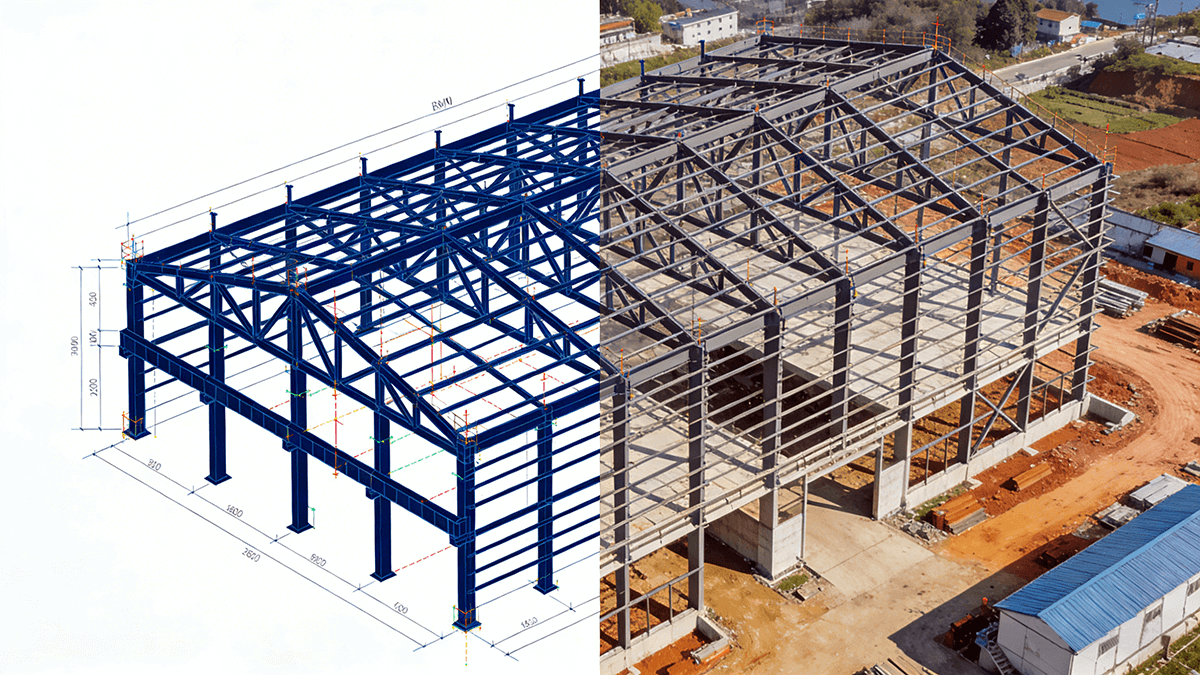
- Wind-responsive framing: Optimised H-beam spacing (max 6.5 m) with reinforced eave connections to meet AS/NZS 1170.2 N3 requirements—validated by third-party wind-tunnel analysis (RWDI report ref. AU-2024-089).
- Zero-bridge insulation system: Triple-layer rock wool sandwich panels (density ≥120 kg/m³) with thermal break gaskets at purlin interfaces—reducing linear thermal transmittance (Ψ-value) to ≤0.03 W/mK, verified via THERM 7.5 modelling.
- Corrosion-hardened envelope: G550 steel base metal + Z275 galvanising (275 g/m²) + epoxy-primer + PVDF topcoat—exceeding AS/NZS 3678 Class C3 and AS 2601 Annex D for sub-zero service life.
Supply chain transparency—no black boxes
You’ll receive a digital Bill of Materials (BOM) with ISO-certified traceability codes for every major component: steel coils (mill test reports from Baosteel), insulation cores (SGS fire-test certificates per AS 1530.3), and fasteners (AS/NZS 1275 compliance stamped on batch labels). All logistics documentation—including CE/AS-marked packing lists and customs-ready origin declarations—is issued 10 days pre-shipment. No surprises at Melbourne Port.
Abnormality management—how we catch issues before they ship
Our production line uses a tiered defect-response protocol: Level 1 (visual surface flaw) triggers immediate rework; Level 2 (dimensional deviation >±1.5 mm) halts the station and logs root cause in our QMS; Level 3 (material certification mismatch) initiates full batch quarantine and supplier audit. In 2025, this prevented 93 non-conforming items from entering final assembly—across 1,842 cold store modules shipped globally.
Full-lifecycle guidance—not just delivery
We advise procurement timing based on actual build rhythm—not sales cycles. For projects like yours: Order structural steel 16 weeks ahead of site handover (lead time includes galvanising + quality hold); Insulated panels 10 weeks ahead (to allow for moisture-vapour barrier integration); and Refrigeration interface kits 6 weeks ahead (pre-assembled with AS 4041-compliant flanges and pressure-test records). This sequence avoids stacking delays and reduces on-site labour dependency.
Local support—engineers, not call-centre staff
We maintain two certified technical representatives in Australia—one in Sydney (NCC Accredited Designer), one in Melbourne (registered with VBA as a Building Practitioner, Class 2). They co-review shop drawings with your certifier, attend pre-fab inspections, and supervise installation of critical junctions (e.g., roof-to-wall thermal breaks, door frame anchoring). Post-completion, we provide a 10-year structural warranty backed by an Australian trust account, audited annually by KPMG APAC.
How we serve you—not just supply
We deliver integrated EPC capability: BIM-coordinated design (Navisworks clash detection included), engineered shop drawings stamped by a Registered Professional Engineer of Queensland (RPEQ), freight-inclusive FOB pricing, and installation supervision with real-time progress reporting. No subcontractor hand-offs. No “design-build” gaps. Just one point of accountability—from concept to commissioning.
Let’s start with engineering—not paperwork
If your site has soil reports, utility layouts, or refrigeration specs—even preliminary ones—send them over. We’ll return a free, no-obligation compliance gap analysis within 5 working days: highlighting which AS/NZS clauses apply, where local amendments matter (e.g., NCC Volume Two Amendment 02 for Victoria), and how our standard details map to your site constraints. No forms. No sales pitch. Just engineering clarity.