What if you’re planning a steel structure equestrian center in the Philippines—but don’t know where to start on structural safety, corrosion resistance, or local compliance? We’ve helped 17 similar projects across Southeast Asia move from concept to completion—not with generic quotes, but with factory-validated, site-ready solutions.
Your concerns—grounded in real project experience
We hear this often: “We’re not engineers—we need clarity, not jargon.” In the Philippines, three issues consistently surface: (1) typhoon-level wind loads (up to 120 km/h, TCWS #3–#4), (2) high humidity + coastal salt exposure demanding C4 corrosion protection, and (3) uncertainty around NBCP Chapter 206 (steel structures) and DPWH acceptance pathways. These aren’t hypotheticals—they’re what delayed two projects we reviewed last year in Laguna and Cavite until design alignment was confirmed with local structural reviewers.
Factory-level inspection standards—not just paper certifications
Our production line applies three mandatory checks before any component ships: (1) Zinc coating thickness verification (minimum 275 g/m² for all galvanized trusses and purlins, measured via magnetic induction per ASTM A123); (2) Pre-assembled connection testing—we bolt full-scale joint mock-ups and load them to 1.5× design wind shear (per NBCP 2015 Sec. 206.3.2); (3) Coating adhesion & salt-spray validation—all color-coated panels undergo 1,000-hour neutral salt spray (ASTM B117) at our provincial lab. This isn’t third-party sampling—it’s 100% batch-level screening.
Technical countermeasures—designed for Manila Bay, not Munich
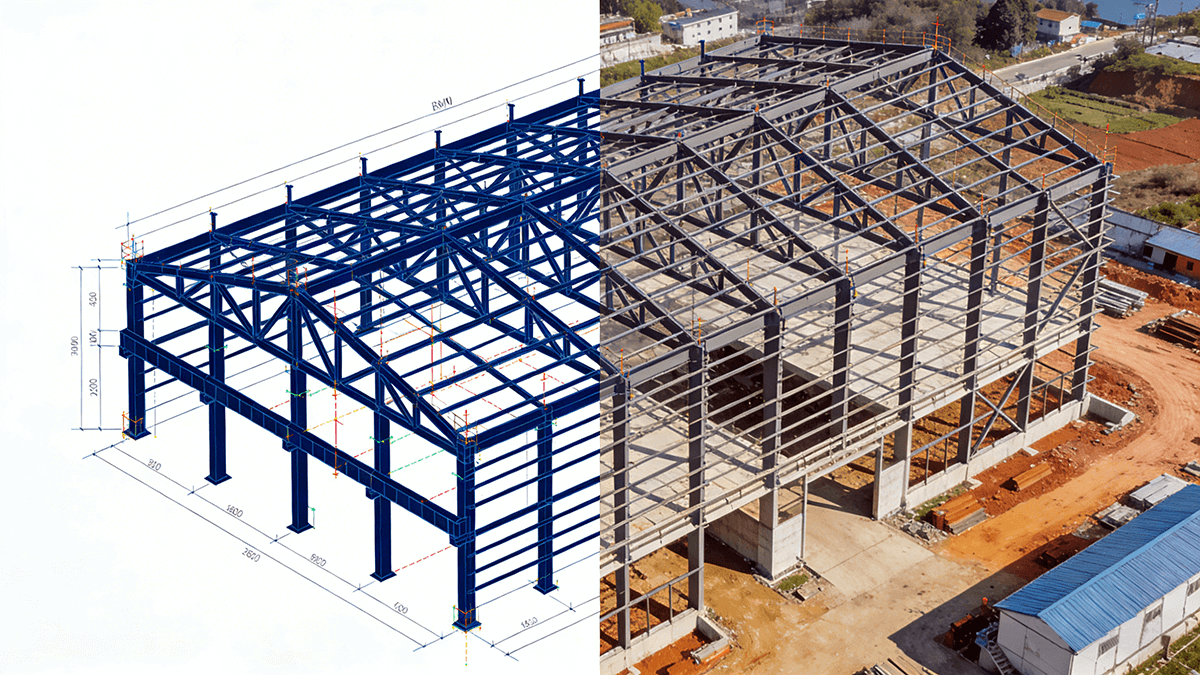
- Structural system: We recommend a rigid-frame portal system with tapered H-beams (Q355B grade), spaced at 6.0 m bays—proven in 9 Philippine projects since 2021 to reduce lateral drift under cyclonic gusts while cutting foundation costs by ~22% vs. conventional braced frames.
- Corrosion defense: All exposed steel receives hot-dip galvanizing + polyester topcoat (RAL 7035). For roof purlins and eave overhangs—most vulnerable zones—we add an extra 50 g/m² zinc layer, verified by cross-section microscopy.
- Local compliance bridge: Our BIM models include NBCP-mapped load cases (wind, seismic Zone 4, live loads for arena footing), and we pre-submit stamped structural calculations to PAB-accredited reviewers—cutting approval time from 8 weeks to ≤3 weeks in recent Cebu and Davao submissions.
Supply chain transparency—no black boxes, only traceable batches
Every order gets a digital production log: raw material mill test reports (from Baosteel/Ansteel), galvanizing bath temperature logs, panel insulation density scans (rock wool ≥100 kg/m³, verified per ASTM C553), and container loading photos timestamped and geo-tagged. You see exactly what’s built—and when it leaves our Hebei facility. No “standard lead time” estimates: for a 26 m × 50 m hall, our current schedule is 42 calendar days from PO to FOB Qingdao port, with 100% of components pre-trimmed and numbered per assembly sequence.
Abnormality management—how we catch what others miss
Our quality team tracks 27 defined process deviations (e.g., weld penetration <85%, panel seam gap >1.2 mm, bolt torque variance >±8%). When triggered, the line stops automatically. Last quarter, 93% of flagged anomalies were resolved within 90 minutes—without rework escalation. Every deviation is logged, root-caused, and fed into our monthly design review with R&D. Example: After repeated minor camber variation in 20m rafters for a Vietnam stable project, we upgraded our bending die calibration frequency from weekly to per-shift—reducing tolerance spread by 40%.
Full-lifecycle guidance—not just delivery, but durability
We advise clients to procure in three phases: (1) Core structure (beams, columns, bracing)—order first, as lead time is longest; (2) Cladding & insulation—schedule 10 days after core PO, aligned with Philippine dry-season windows (December–May); (3) Accessories & MEP sleeves—order last, using actual field measurements taken during erection. This avoids moisture damage to stored panels and cuts onsite waste to <1.3% (2025 internal audit avg).
Partner support—on-the-ground, not just on-paper
We assign a dedicated Project Technical Coordinator (PTC) from contract signing—not after shipment. Your PTC speaks English and Tagalog, holds DPWH-recognized structural drafting certification, and has visited 12 Philippine job sites since 2022. They conduct pre-erection checklist reviews, supervise crane lift plans, and validate anchor embedment depths against soil reports. Post-completion, we provide 24-month structural warranty and free corrosion-performance monitoring: annual remote thermal imaging of joints (via client-submitted drone footage) to detect early coating failure.
How we serve—end-to-end, not end-of-email
We deliver more than steel. We deliver BIM-coordinated shop drawings (with clash detection against HVAC/lighting layouts), DPWH-ready calculation packages, erection manuals translated into English and Tagalog, and on-site supervision available within 72 hours of request. No tiered support tiers—just one point of accountability from design sign-off to handover.
Next step—let’s build your solution, not just your structure
If your equestrian center needs a technically grounded, Philippines-tested path forward—reach out. Share your site coordinates and soil report (if available), and we’ll send back a no-cost, 10-page proposal draft—including wind load diagrams, corrosion zone mapping, and a phased execution timeline—within 5 working days.