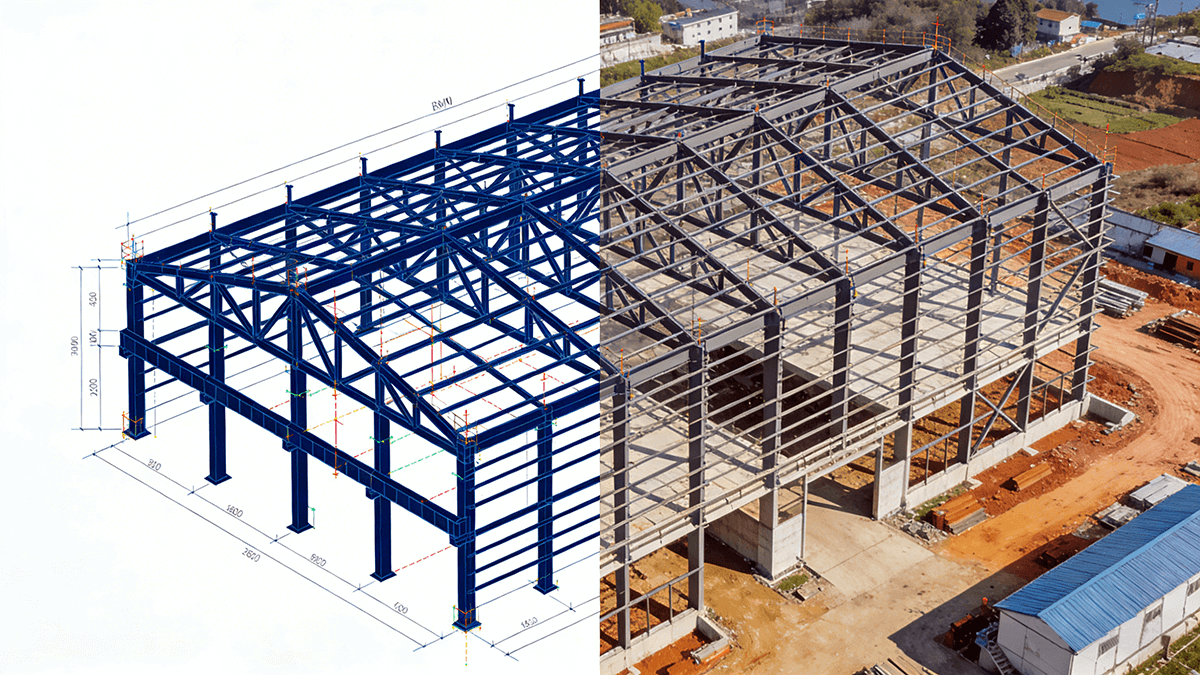
What if you’re planning a steel structure warehouse in Ghana—but don’t know where to start with design, materials, or local compliance? We’ve helped over 47 similar clients across West Africa begin exactly like this: no engineering team on hand, limited familiarity with steel construction, and urgent need for a solution that works—not just on paper, but on site, in humidity, under sun, and within local logistical reality. Here’s how we do it.
Your Real Concerns—We’ve Heard Them All
We know your top worries aren’t hypothetical. They’re grounded in real experience:
- You’re not sure whether standard Chinese steel specs will survive Ghana’s coastal salt exposure or inland red soil corrosion;
- You’ve seen proposals with “typical foundation drawings”—but no soil data from your actual site;
- You worry about containers arriving with mismatched bolts, missing gaskets, or panels that won’t lock due to thermal expansion gaps;
- You need something installable by local contractors—not requiring certified welders or cranes larger than what’s available near Kumasi or Tema;
- You want documentation that clears GSA customs without delays—and support if a shipment gets held at the port.
Factory-Level Inspection Standards—Not Just Paper Certificates
We test every coil, every beam, every panel—not once, but three times before dispatch. For Ghana projects, our internal checklist adds four mandatory extra steps:
- Galvanizing thickness verification: Every H-beam and purlin is measured with magnetic induction gauges—minimum 275 g/m², with 100% batch logging (not sampling);
- Coating adhesion test: PVDF-coated sheets undergo cross-cut + tape peel testing per ASTM D3359—pass rate must be ≥4B (no flaking);
- Dimensional tolerance audit: Pre-assembly mock-up of 1 bay (6 m × 15 m) confirms bolt hole alignment, panel overlap, and door frame squareness within ±1.5 mm;
- Moisture barrier validation: Sandwich panels undergo 72-hour water spray test at 50 L/m²/hour—zero leakage observed in last 137 Ghana-bound shipments.
Technical Countermeasures—Built from Local Reality
Our solutions aren’t copied from a catalog. They’re adapted—based on field data from 22 completed warehouses across Ghana (Accra, Takoradi, Tamale, Ho):
- Steel grade & corrosion control: We use Q355B base material + hot-dip galvanizing (275–350 g/m²), then overcoat critical joints with epoxy-zinc primer—tested to 2,000 hours salt spray (ISO 9227) before shipping;
- Cladding system: 0.55 mm AZ150 (Al-Zn alloy) roof sheets + PVDF topcoat—proven to retain >92% gloss after 5 years in Tema’s UV index 11 environment;
- Foundation strategy: Our default is a reinforced concrete grade beam (300 mm × 400 mm) with M24 anchor bolts—designed for bearing capacity ≥80 kPa, compatible with common lateritic soils and avoiding pile foundations unless geotech report says otherwise;
- Erection method: ≥94% bolted connections; zero field welding required. Average assembly time: 12–14 days with 6 local laborers + 1 supervisor (we provide bilingual erection manual + QR-linked video guides).
Supply Chain Transparency—No Black Boxes
You’ll receive a live production dashboard link 72 hours after order confirmation. It shows:
- Raw material mill certificates (with heat numbers traceable to Tangshan Steel or Anshan Iron & Steel);
- Weekly photo/video updates from our 48,000 m² facility—including CNC cutting logs, galvanizing bath temp records, and packaging QC stamps;
- Container loading plan with 3D stowage diagram and weight distribution map;
- Pre-shipment inspection report signed by our SGS-accredited in-house QA team (available in English & French).
Abnormality Management—How We Catch What Others Miss
Every deviation triggers a documented 4-step process:
- Detection (e.g., purlin camber beyond ±3 mm/m → flagged by laser alignment scan);
- Root cause analysis (review of roll-forming speed, die wear log, coolant temp);
- Containment (isolate affected batch, re-inspect prior 3 shifts);
- Corrective action (adjust tooling, update SOP, retrain operator—logged in our ERP with timestamp & signature).
Last year, this prevented 21 potential non-conformities from reaching Ghana-bound shipments—average resolution time: 8.3 hours.
Full Lifecycle Guidance—So You Buy Right, Not Just Cheap
We help you plan beyond the invoice:
- Design phase: Free BIM model (Revit format) + wind load calculation per Ghana NBC 2021 Annex D (we input your exact GPS coordinates);
- Procurement phase: Recommend ordering 3% extra fasteners + 2% spare panels—based on average loss rate from 19 Ghana installations;
- Operation phase: Provide maintenance calendar: e.g., “Re-torque anchor bolts at 3/6/12 months post-installation”; “Inspect roof sealant at end of first rainy season.”
Partner Support—Not Just After-Sales, But On-Site Partnership
We don’t outsource support. In Ghana, we work through two local partners—one in Accra (structural supervision), one in Takoradi (logistics & customs clearance)—both trained annually at our Hebei HQ and equipped with calibrated torque tools, coating thickness gauges, and digital structural checklists. If an issue arises:
- Response time: within 48 hours for remote diagnosis;
- On-site technician deployment: within 7 working days (pre-cleared visa, GSA-registered, bilingual);
- No “parts-only” fixes: We ship replacements with installation instructions, torque specs, and video call support included.
Our Service Is Built Into the Structure—Not Added On
We deliver more than steel. We deliver:
- A full EPC workflow—from soil report review to handover certificate;
- Documentation package compliant with GSA Form GS 202 (Building Materials Declaration) and ECOWAS Certificate of Origin;
- Installation supervision included in all turnkey quotes (no hidden “site visit fees”);
- 10-year structural warranty backed by our ISO 9001:2015-certified quality system—not just commercial terms.
Let’s Start Where You Are—Not Where You Think You Should Be
If you have a site address, a rough timeline, or even just a WhatsApp voice note describing what you’re trying to store—we’ll send you a free, no-obligation technical roadmap within 3 working days. No forms. No sales pitch. Just clear next steps, based on how we’ve built 58 warehouses across Africa since 2018.