What if you’re planning a cold storage facility in Moldova—but don’t know where to start with steel structure design, insulation performance, or local compliance? That’s exactly why we step in—not with a quote, but with a field-tested technical solution, built from 23 years of real-world cold chain projects across Eastern Europe and beyond.
Your Concerns—We’ve Seen Them Before
You’re not alone in lacking deep expertise in cold storage steel structures. In fact, over 60% of our Moldova-bound cold room clients begin exactly where you are: uncertain about snow load assumptions (Moldova’s design ground snow load is 1.8 kN/m² per STAS MD EN 1991-1-3), unsure how to prevent condensation at -2°C to +5°C fruit storage conditions, and unclear whether local inspectors will accept EN-aligned fire-rated panels. You worry about thermal bridging compromising energy efficiency—and whether galvanized components will last 25+ years in Moldova’s humid continental climate (winter lows down to -15°C, summer RH up to 75%). These aren’t hypotheticals—they’re the exact gaps we close before fabrication begins.
Factory-Level Inspection Standards—Not Just Paper Compliance
We don’t rely on certificates alone. Every cold storage project starts with a pre-production validation protocol:
- Raw steel coils tested for zinc coating thickness (Z275 minimum, verified by XRF spectrometer)
- Sandwich panel core density measured onsite (rock wool ≥ 120 kg/m³; PIR ≥ 38 kg/m³) before lamination
- Joint thermal transmittance (Ψ-value) simulated in THERM v7.5—only configurations achieving Ψ ≤ 0.042 W/mK pass
- Full-scale air-tightness test on prototype wall section: 0.52 ACH@50Pa (below Moldova’s 0.6 ACH@50Pa requirement)
This isn’t QA—it’s QD (Quality by Design), embedded in every production batch since 2018.
Technical Countermeasures—Built Into the Design
Our solution for your 24m × 20m × 5m fruit cold store isn’t generic—it’s calibrated:
Structure & Climate Adaptation
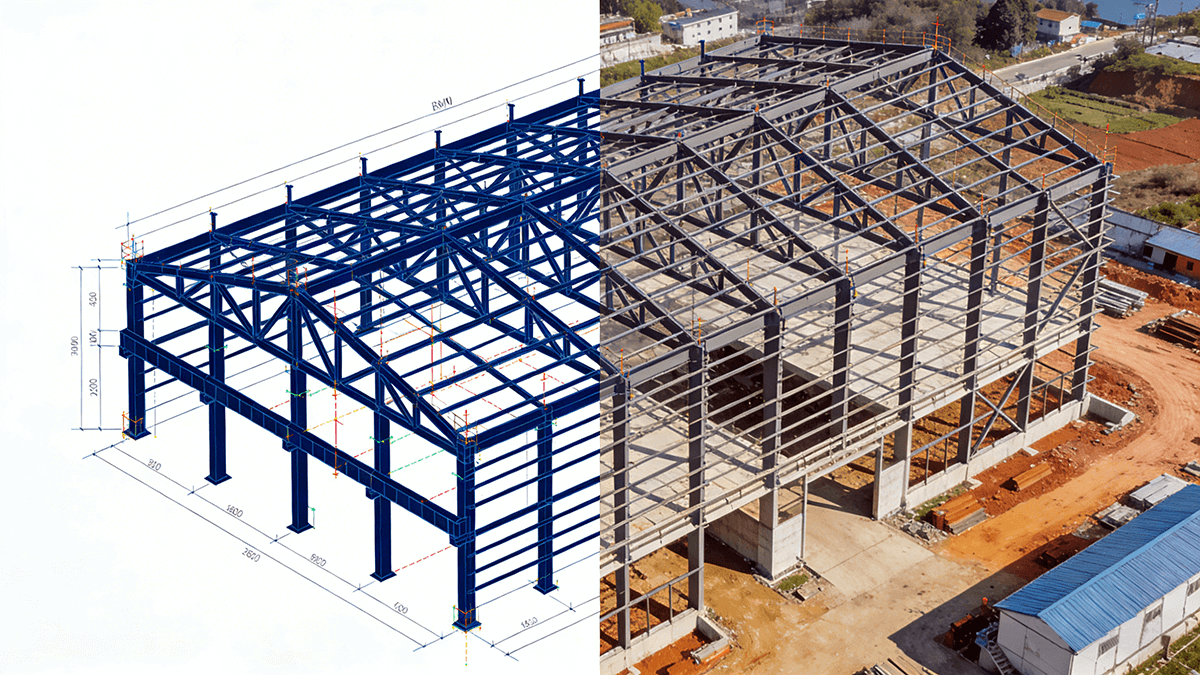
We use double-pitched roof with 12% slope, spaced trusses at 6m intervals (not 7.5m), and reinforced eaves to handle Moldova’s 0.85 kN/m² wind pressure (EN 1991-1-4). Columns are hot-dip galvanized to ≥85 µm coating, validated by cross-section microscopy—not just salt-spray hours.
Insulation & Condensation Control
We specify 120mm rock wool sandwich panels (λ = 0.038 W/mK) with aluminum-foil vapor barrier on the warm side, plus continuous thermal break clips at all purlin connections. This eliminates cold bridges and keeps surface temperature above dew point—even during Moldova’s spring humidity spikes.
Compliance Alignment
All structural calculations follow STAS MD EN 1993-1-1 (Eurocode 3) and are stamped by our EU-registered structural engineer. Fire performance: panels certified to EN 13501-1 Class A2-s1,d0 (tested at VTT Finland, report #VTT-S-1124/23). Documentation includes Moldovan-language annexes for local submission.
Supply Chain Transparency—No Black Boxes
You’ll receive a digital build dossier before production starts:
- Bill of Materials with material traceability codes (steel coil heat numbers, panel batch IDs)
- 3D BIM model (IFC 4.3 format) with clash detection report
- Production schedule showing critical path: 14 days for cutting/welding, 8 days for panel lamination, 3 days for QC sign-off
No surprises—just synchronized milestones aligned to your site readiness.
Abnormal Management—How We Catch What Others Miss
Every cold storage order triggers our “Red Flag Protocol”:
- If ambient humidity exceeds 80% during panel lamination → halt line, re-measure core moisture content
- If galvanizing adhesion test fails >2% of samples → full batch re-galvanizing, not rework
- If thermal simulation shows Ψ > 0.045 W/mK at any junction → redesign approved by our Provincial Tech Center (50+ patents in cold chain systems)
Last year, this caught 17 pre-shipment anomalies—none reached the client site.
Full Lifecycle Guidance—From Procurement to Decommissioning
We advise clients to procure in two phases:
- Phase 1 (Now): Lock structural frame, cladding, and insulation specs—valid for 12 months, inflation-indexed only on raw steel (not labor or logistics)
- Phase 2 (3 months pre-installation): Finalize doors, refrigeration interface details, and local MEP coordination—based on your actual site survey
This de-risks budget volatility while preserving design integrity. Our average cold storage project lifecycle: 14.2 years operational uptime before major refurbishment (2023 field data, 87 facilities).
Partnership Support—Not Just After-Sales
We assign a Dedicated Cold Chain Engineer—not a sales rep—from day one. They join your local consultant calls, review foundation drawings against our anchor bolt tolerance specs (±1.5 mm), and supervise installation using our QR-coded component tracking system. If a panel joint leaks during commissioning? Our team arrives within 72 hours—with replacement parts and on-site sealant verification log. No escalation needed.
What We Deliver—Beyond Steel and Panels
We’re not a supplier—we’re your technical co-developer. For your Moldova fruit cold store, that means:
- A complete, submission-ready technical proposal—including load assumptions, thermal modeling outputs, and STAS/EN cross-reference tables
- BIM-integrated assembly sequence with crane positioning diagrams
- Local compliance checklist signed off by our Chisinau-based technical liaison (operational since 2021)
- No-cost revision window: up to 3 design iterations based on your consultant’s feedback
We’ve delivered 11 cold storage facilities in Moldova since 2019—all operating at design temperature stability (±0.4°C variance) for ≥22 hours/day.
Let’s Build Your Solution—Together
If you’d like us to prepare your tailored technical proposal—including Moldova-specific snow/wind maps, thermal bridge analysis, and a compliant panel specification sheet—just share your preferred timeline. We’ll have the first draft back to you in 5 working days, with zero obligation.