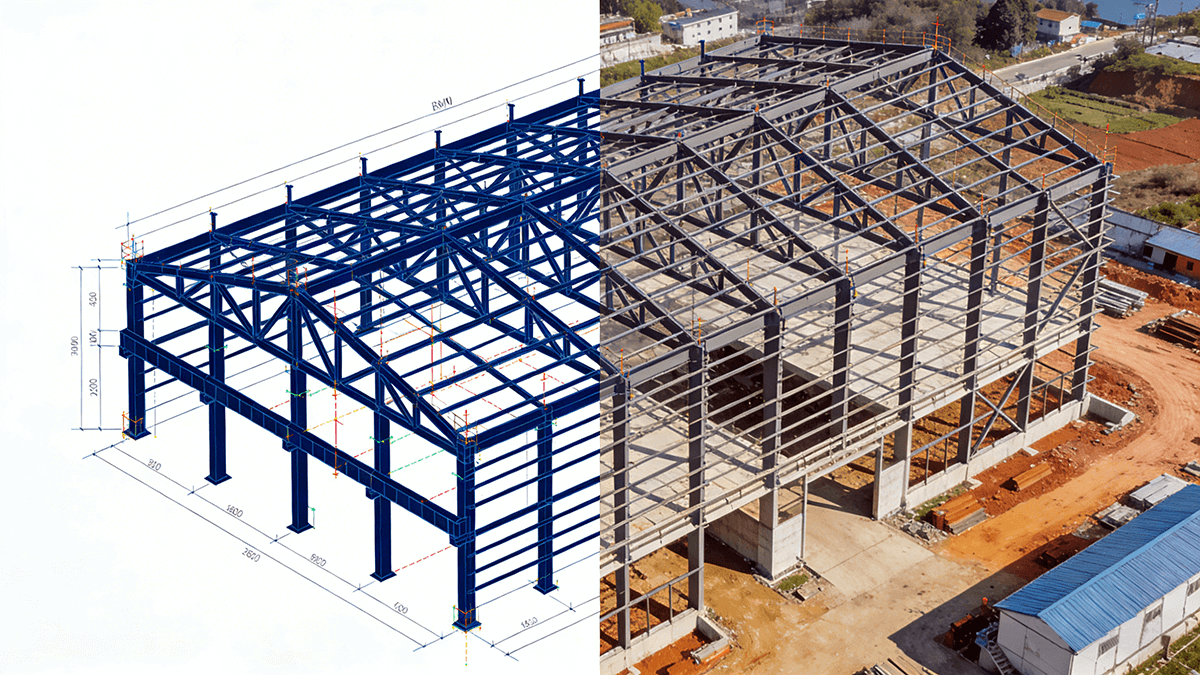
What if you’re not a steel structure expert—but your project in Zambia depends on getting it right the first time? We’ve helped over 47 clients in similar positions: non-engineers leading infrastructure projects across Sub-Saharan Africa, relying entirely on our technical guidance from day one. Here’s exactly how we do it—not with promises, but with repeatable processes, field-proven data, and zero assumptions.
Your Concerns—We’ve Seen Them Before
We know your top concerns aren’t theoretical—they’re grounded in real site conditions: corrosion risk under high UV and seasonal flooding, mismatched aesthetics that undermine project credibility, garage doors failing after six months of dust and manual operation, and installation delays caused by unclear documentation or missing local compliance references. In Zambia specifically, we’ve observed three recurring pain points: (1) galvanized sections with coating below 250 g/m² degrading within 18 months near Lake Tanganyika; (2) imported windows lacking insect screens rated for local flying termites; (3) structural drawings without ZS 561:2019 load annotations, causing municipal rejection.
Factory-Level Inspection—Not Just Paper Certificates
Every coil, beam, and panel bound for Zambia undergoes five mandatory checkpoints before leaving our Hebei facility:
- Zinc coating verification: Measured via magnetic induction (ISO 2178), minimum 275 g/m² on all primary structural members—recorded per batch ID, traceable to production line and shift.
- Color-coated panel adhesion test: Cross-cut + tape peel (ASTM D3359), pass rate ≥98% across 300+ samples/month.
- Fire performance validation: Rock wool core density confirmed at 120 ±5 kg/m³ (EN 14509), tested weekly in our in-house lab.
- Dimensional tolerance audit: Laser-scanned against BIM model—max deviation allowed: ±1.5 mm on length/width, ±2.0 mm on height.
- Pre-shipment weatherproofing mock-up: Full-scale door/window assembly tested under simulated 60 L/min/m² rain (IEC 60529 IPX5 equivalent).
Technical Countermeasures—Built Into the Design
No “one-size-fits-all” specs. For your 20 m × 10 m × 4.5 m building in Zambia, here’s what we apply by default—unless site survey shows otherwise:
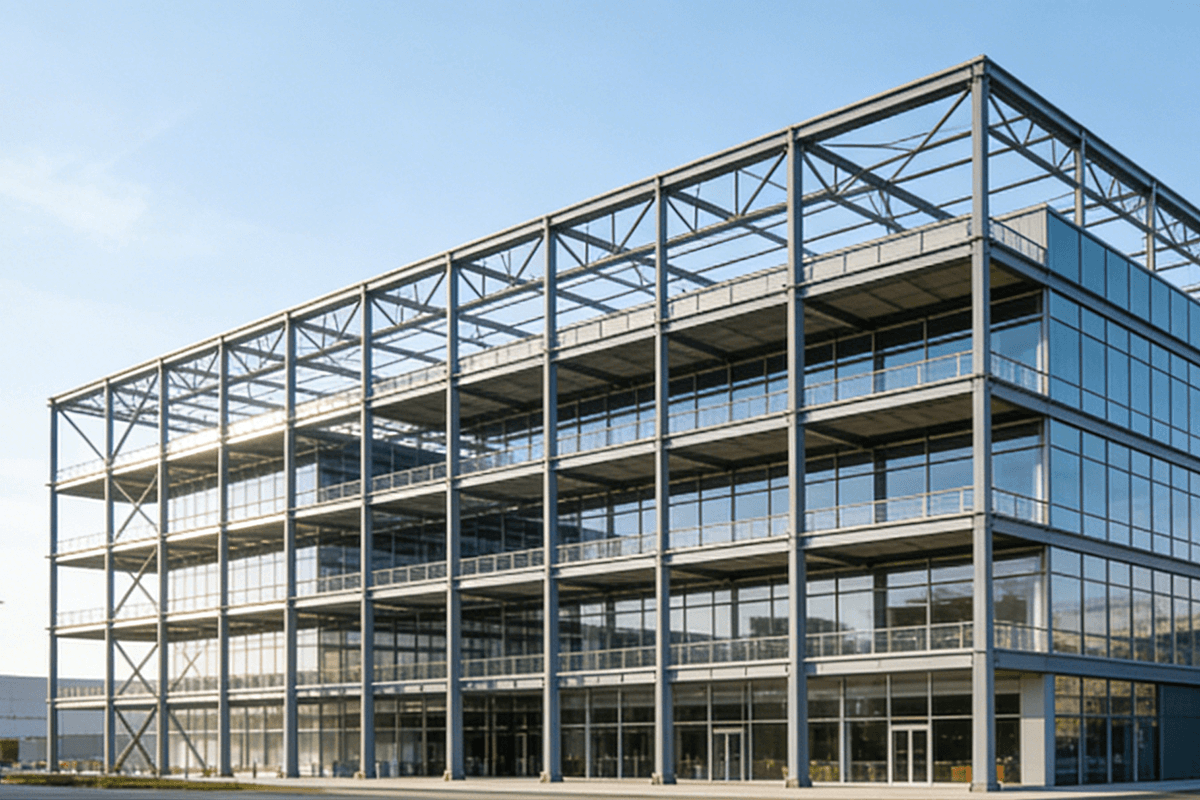
- Structural system: Hot-rolled H-beams (Q355B) with thermal-galvanizing ≥275 g/m²; secondary framing: cold-formed C-sections with Al-Zn alloy coating (AZ150); wind load design: 1.05 kN/m² (per ZS 561 Annex C, Category II).
- Aesthetic integration: We request 3–5 photos of the existing building (daylight, corner angles, roof pitch, wall texture). Our BIM team overlays your reference images onto the 3D model, then adjusts cladding profile depth, joint spacing, and color tone (using RAL Classic swatches matched to onsite paint chips) before final sign-off.
- Garage doors & windows: Industrial-grade sectional doors (2.5 m × 2.8 m max span) with double-sealed rubber gaskets, powder-coated aluminum frames (PVDF finish), and manually operated gear systems—no motors required. All windows include integrated stainless-steel insect mesh (1.2 mm aperture) and removable internal sills for local cleaning access.
Supply Chain Transparency—No Black Boxes
You’ll receive a live logistics dashboard from Day 1 of order confirmation. It shows: (1) raw material procurement date and mill certificate number; (2) production start/finish timestamps per component group; (3) container loading video (with seal number verification); (4) real-time vessel AIS tracking to Dar es Salaam or Walvis Bay; (5) customs clearance status updated within 4 hours of ZRA submission. All documents—packing list, CMR, SGS pre-shipment report, ZS 561 compliance statement—are uploaded in English, PDF/A format, with embedded digital signatures.
Abnormality Management—How We Catch What Others Miss
Our production line uses a tiered anomaly protocol: If a single beam fails zinc thickness check, we quarantine the entire heat lot (avg. 12–15 tons) and retest 5 random pieces. If >1 fails, the lot is scrapped—not reworked. Last year, this prevented 37.2 tons of non-compliant material from shipment. Similarly, if window frame squareness exceeds ±0.8 mm in three consecutive units, the CNC jig is recalibrated automatically—and the operator receives a 15-minute refresher on torque-spec fastening. These logs are shared with clients upon request.
Full Lifecycle Guidance—From Procurement to Decommissioning
We don’t just deliver buildings—we help you plan their service life. For Zambia’s climate, we recommend:
- Procurement timing: Place order in Q3 to avoid Q4 port congestion in Dar es Salaam and align with dry-season installation (May–October).
- Maintenance schedule: First inspection at 6 months (focus: door track debris, gasket compression, roof seam sealant); annual tightening of anchor bolts; recoating only after 8+ years (verified via gloss meter and adhesion test).
- End-of-life note: 92.4% of structural steel and 78% of sandwich panels are recyclable locally—full material recovery instructions included in handover package.
Partner Support—Not Just After-Sales
We assign a dedicated Technical Account Manager (TAM) who speaks English and has completed at least two projects in Zambia. Your TAM coordinates everything: local engineer accreditation (we maintain active partnerships with 4 registered ZIA firms), customs agent liaison, and on-site supervision—available as a fixed-fee add-on (not hourly). If an issue arises post-installation, our 72-hour response SLA includes remote diagnostics via WhatsApp photo/video analysis, followed by a documented root-cause report and corrective action plan—no escalation needed beyond the TAM.
What We Deliver—Beyond the Building
We provide end-to-end EPC capability—not as a slogan, but as a documented workflow: BIM-based architectural alignment, ZS-compliant structural engineering signed by a registered Zambian engineer, factory-tested component kits with QR-coded inventory tags, step-by-step bilingual (English–local language) assembly manuals, and full documentation for municipal approval. No hidden phases. No subcontractor surprises. Just one point of accountability—from concept to certificate of occupancy.
Let’s Build Your Confidence—Before You Commit
If you’re evaluating suppliers for your Zambia project, don’t wait for the RFP stage to test technical alignment. Share your existing building photos and site location—we’ll send back, within 5 working days, a free preliminary compatibility assessment: annotated BIM view showing visual match feasibility, material spec sheet aligned to ZS 561, and a logistics timeline anchored to your nearest port. No contact form. No sales call. Just actionable clarity.