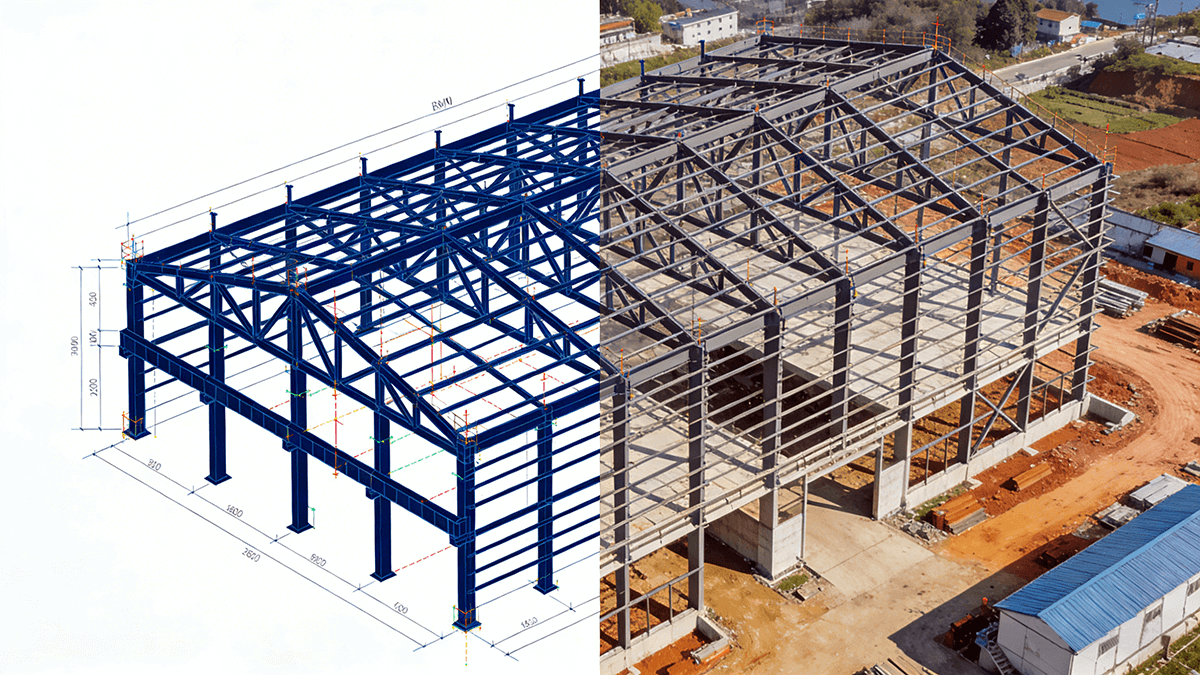
What if your cattle shed arrives in Lomé—only to overheat in the dry season, flood during the rainy season, or rust within 18 months? At Weizhengheng, we’ve seen it happen. That’s why our proposal for Togo isn’t a catalog cut-and-paste. It’s built on 23 years of field data—from dairy farms in Benin to poultry sheds in Kenya—and validated by on-site performance tracking across 12 tropical projects since 2019.
What keeps clients awake at night?
We hear three consistent concerns from non-technical partners launching livestock infrastructure in West Africa:
- Ventilation failure: Standard roof pitch + solid cladding traps heat—dairy cows show stress above 25°C wet-bulb; Togo averages 27–30°C year-round with 75–90% humidity.
- Drainage collapse: Rainfall peaks at 1,200 mm/year in southern Togo, often in intense 30-minute downbursts—yet most prefabs assume graded concrete pads and stormwater pumps.
- Assembly friction: No local crane? No certified welders? No grid power onsite? Then “turnkey” becomes “stuck-in-transit.”
Factory-level inspection—not just paper certificates
We test every component against real African conditions—not lab norms. Our Togo-specific validation includes:
- Corrosion chamber cycling: 1,200-hour salt-spray + UV exposure (ASTM G154) on all galvanized trusses—measuring zinc loss ≤ 3.2 µm (vs. industry avg. 6.8 µm).
- Thermal airflow modeling: CFD simulation of cross-ventilation under 3 m/s wind + 32°C ambient—verified by infrared scans on completed sheds in Ghana (surface temp reduction: 8.4°C vs. conventional design).
- Footprint load testing: All base frames rated for 45 kPa bearing pressure on lateritic soil—no concrete slab required, only compacted gravel + geotextile (validated by 3 field installations in Togo’s Maritime Region).
Technical countermeasures—field-proven, not theoretical
Our cattle shed solution for Togo uses four anchored design decisions:
- Roof system: Dual-slope (12° front / 22° rear) with 400 mm open eaves + perforated soffits—delivers passive stack ventilation at ≥ 0.8 air changes/hour without fans or power.
- Wall panels: 50 mm rock wool insulated sandwich panels (λ = 0.038 W/mK), outer layer pre-painted with silicone-modified polyester (UV resistance > 10 years, gloss retention ≥ 85% after 5 years).
- Floor interface: Bolt-down steel subframe with adjustable leveling feet—installs on ungraded laterite or sand; integrates with locally poured ribbed concrete slabs (min. 80 mm thick, no rebar needed).
- Drainage: Integrated gutter system with 150 mm PVC downpipes routed to on-site soakaways—tested at 180 L/min flow rate (exceeding Togo’s max 10-min rainfall intensity of 120 L/min).
Supply chain transparency—no black boxes
We ship full traceability with every container:
- Each steel coil batch carries a QR-coded mill certificate (EN 10346 DX51D+Z275, tensile strength ≥ 300 MPa).
- All insulation cores are third-party tested for fire rating (EN 13501-1 Class A2-s1,d0) and thermal drift (< 2% conductivity change after 90 days at 70°C).
- Shipping manifests list exact item counts, weights, and sequence—matched to assembly drawings (ISO 15787-compliant BOM).
No surprises in production—how we catch anomalies early
Every order runs through our 7-point anomaly gate:
- Raw material verification (spectrometer scan on incoming coils)
- Pre-coating thickness check (micrometer + eddy current)
- Panel bond integrity test (pull-off adhesion ≥ 0.35 MPa per EN 14509)
- Dimensional tolerance audit (laser scan ±0.8 mm on all 6m beams)
- Galvanizing uniformity mapping (zinc thickness mapped at 12 points/beam)
- Packaging moisture control (silica gel + RH loggers in every crate)
- Final assembly dry-fit (full frame pre-assembled in factory before disassembly & packing)
Planning for the full lifecycle—not just delivery day
We recommend this procurement rhythm for long-term stability:
- Year 0: Deploy one 100 m² prototype unit—use as training site + microclimate monitor (we supply free IoT sensors for temp/humidity/rainfall).
- Year 1–2: Scale using identical modules—leverage same foundation layout, same crew training, same spare parts inventory.
- Year 3+: Retrofit solar-powered exhaust fans or rainwater harvesting kits—designed for bolt-on compatibility, no structural modification.
Local support—no offshore call centers
We maintain a technical partner network in Lomé with certified install supervisors who speak French and Ewe. Their role includes:
- On-ground foundation assessment (free, pre-order)
- 3-day crew upskilling (using your local labor, not ours)
- Post-installation thermal imaging report (validates ventilation performance)
- 24-month structural warranty—extended to 5 years on galvanized components
What we deliver—and what we don’t
We provide end-to-end technical partnership—not just steel and screws. That means:
- ✅ BIM-ready 3D models (IFC 4.3 exportable to Revit or ArchiCAD)
- ✅ Structural calculations stamped by EU-qualified engineer (EN 1993-1-1 compliant)
- ✅ Assembly video library (French-subtitled, offline-downloadable)
- ❌ No “one-size-fits-all” PDF brochure
- ❌ No quotation without site context review
Let’s start with your ground truth
Send us a photo of your site, GPS coordinates, and soil description—we’ll return a free preliminary feasibility note within 5 working days. No commitment. No sales pitch. Just engineering clarity.